9 min read Tanja
Is AI Rejecting Your Resume? Your 7 Rights as an Applicant in 2026

Direct Answer: Yes, an algorithm is probably reading your resume before any human does. But you are not powerless: as a job applicant in 2026 you have 7 rights when AI is used to screen you, and in the EU a fully automated rejection without human involvement is generally not permitted. The strongest of these rights, the right to a meaningful explanation under the EU AI Act, applies from August 2026, while the full high-risk regime for hiring AI was pushed to 2 December 2027.
You send out application after application and barely hear back. It’s a familiar feeling, and it’s fueled a familiar fear: that a machine threw your resume out before a person ever looked at it. Sometimes that fear is justified. AI now sits on both sides of the hiring table. Employers use it to rank, score, and filter candidates; you can use it to make sure your real qualifications are read correctly. And if the flip side worries you, we’ve also examined whether recruiters can actually tell you used AI to write your resume.
Here’s the part most articles skip: the law has caught up, and it’s now firmly on your side. This is a plain-language guide to your 7 rights, who they apply to, and what actually changed, including a date correction that most coverage still gets wrong.
This isn’t legal advice. Think of it as a map of where you stand.
Most mid-to-large employers now run applications through some form of automated triage: an applicant tracking system that parses and ranks resumes, a matching algorithm that scores you against the job description, a chatbot that pre-screens, or a video tool that assesses recorded interviews. Surveys consistently show a majority of large employers use some automated assistance in recruitment. The same wave has a darker edge, too: it’s made fake recruiters and deepfake job scams easier to pull off, so a little skepticism cuts both ways.
The discomfort is real, and so is the distrust. Surveys cited in EU policy discussions suggest that only a minority of job applicants trust AI systems to evaluate them fairly. The regulators noticed. That’s why hiring AI is treated as “high-risk” under the EU AI Act, the same category as AI used in credit scoring and law enforcement.
The takeaway isn’t “AI is the enemy.” It’s that an automated first pass is now normal, so the two things that matter are knowing your rights and making sure the system reads you accurately.
How does your resume score?
Check Your Score FreeIn the EU these rights come from two sources working together: the General Data Protection Regulation (GDPR), Article 22, which has applied since 2018, and the new EU AI Act, Article 86. Together they give you 7 concrete rights:
Which of these reach you depends on where you are and where the job is. The full set applies most clearly inside the EU. But as you’ll see, they can follow you across borders too.
This is where most articles are now wrong, so read carefully. The EU AI Act phases in over several years, and the timeline shifted in 2026.
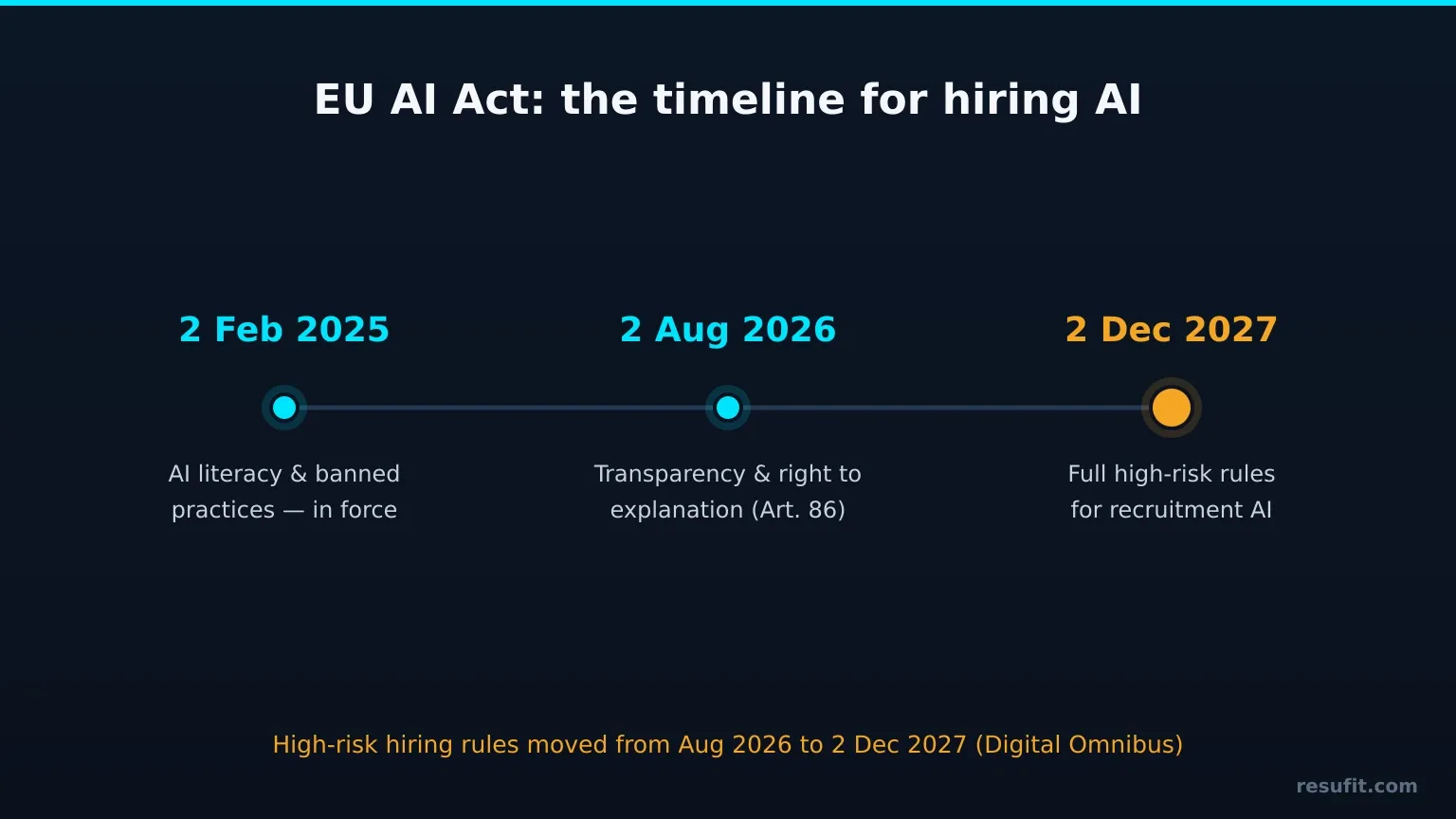
That last date is the correction. The high-risk hiring rules were originally set for August 2026, but on 7 May 2026 EU lawmakers reached a provisional agreement on the “Digital Omnibus on AI” that deferred them by roughly 16 months, as reported by Fisher Phillips. If you see an article confidently stating “the rules apply in August 2026,” it predates that change. The European Commission’s own AI Act overview now reflects the later employment date.
What this means for you in practice: the right to be informed and to ask for an explanation arrives in 2026, while the heavier compliance machinery employers must build lands at the end of 2027. It’s not the only EU rule reshaping hiring right now either, the pay transparency directive is changing what employers must disclose about salary in the same period.
Short answer: it can, even if your employer has no EU office.
The Act has extraterritorial reach. It applies whenever the output of an AI system is used in the EU, or the affected person is located in the EU, regardless of where the company is based. A Texas HR platform screening resumes for a French employer, or a UK agency placing a candidate into a role in Berlin, is squarely in scope. The point is to stop companies from dodging the rules by simply running the algorithm offshore.
So the threshold question isn’t “is my employer European?” It’s “is this AI being used to make a decision that touches the EU?” If yes, the 7 rights above are in play.
This is the part expats and remote job seekers miss. If you’re an American, Indian, or British applicant going for an EU-based or EU-remote role, you aren’t outside the system looking in. Because both the AI Act and GDPR follow the candidate and the place where the decision lands, an applicant being considered for an EU position can claim the right to be informed, the right to a human in the loop, and the right to an explanation.
Practically, that means if a European employer’s AI screens you out, you can ask, in writing, whether an automated system was used and request a meaningful explanation. Most candidates never ask. The ones who do often learn more about why they were filtered, which is information you can act on.
There’s no single US federal AI hiring law. Instead, a patchwork of state and city rules has grown, and it shifted in 2026:
The throughline across all three: notice when AI is used, protection against discriminatory outcomes, and in several cases a path to human review.
The UK didn’t adopt the EU AI Act. But that doesn’t mean a free-for-all. Under UK GDPR Article 22, you have rights around solely automated decisions, including the right to human intervention and to contest. The Information Commissioner’s Office has published guidance on AI in recruitment, and the Equality Act 2010 still bans discriminatory outcomes however they’re produced. And remember: a UK candidate applying to an EU role is back under the EU AI Act through its extraterritorial reach.
Knowing your rights protects you after the fact. Getting read correctly in the first place is what keeps you in the running. A few things that genuinely help:
The goal isn’t to trick the machine. It’s to make sure your genuine qualifications aren’t lost in translation between you and the parser. That’s the legitimate side of the table you control. Resufit aligns your resume to a specific job description so a screening system reads your real experience accurately, then helps you tailor each application without starting from scratch.
AI on the hiring side isn’t going away. But in 2026 you walk in with 7 rights, a clear timeline, and a resume that’s built to be read. That’s a very different position from refreshing your inbox and hoping.
Ready to build a winning resume?
Create Your Resume FreeGet the latest tips on resume writing and career advice.
Often an algorithm ranks or filters your application before a human sees it, but in the EU a fully automated rejection without human involvement is generally not allowed. You have 7 enforceable rights when AI is used to screen you, including the right to human review.
Yes, if the output of the AI system is used in the EU or affects a person located in the EU. A US or UK employer hiring for an EU-based or EU-remote role is covered, regardless of where the company is headquartered.
In phases. AI literacy and banned practices have applied since February 2025. Transparency duties and the right to an explanation apply from August 2026. The full high-risk regime for recruitment AI was deferred to 2 December 2027 under the Digital Omnibus agreed in May 2026.
In the EU and UK you can ask. Under GDPR Article 22 and AI Act Article 86 you have the right to be told an automated system was involved and to receive a meaningful explanation. In the US it depends on the state, such as Illinois and New York City.
Because the EU AI Act and GDPR follow the candidate, an applicant located in the EU, or being placed into an EU role, can claim the same rights even if the employer sits in the US, UK or elsewhere.
Match the real language of the job description, use a clean machine-readable layout, and keep your achievements specific and quantified. The goal is to help the system read your genuine qualifications correctly, not to trick it.