9 min read ResuFit Team
Simple Resume Format for Freshers: The 5-Section Structure for No Experience
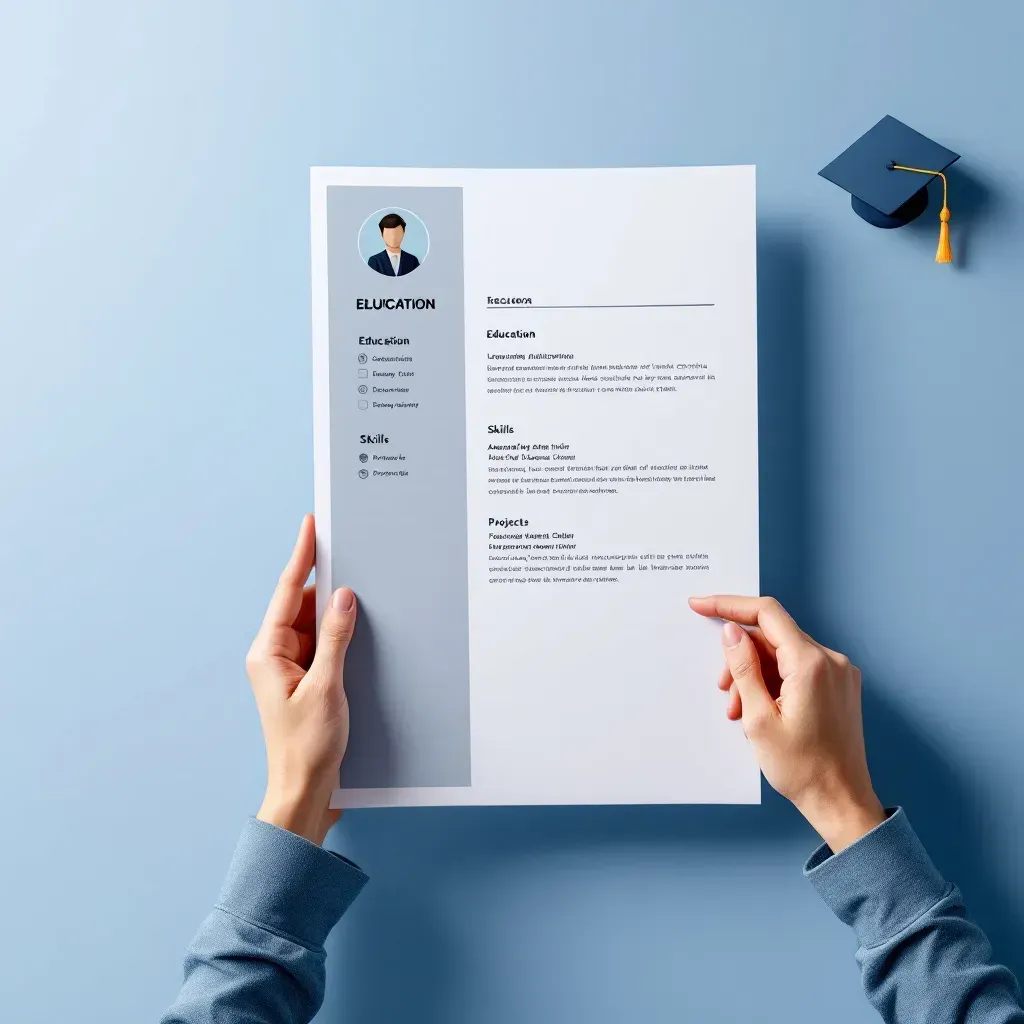
The best resume format for freshers with no experience is a simple, one-page layout built from 5 sections: header, summary, education, experience, and skills. This structure works because it leads with what a fresher has (education, projects, activities) instead of a job history that does not exist yet. Below is exactly how to build it, section by section, with real examples.
TL;DR: Use the 5-section format (header, summary, education, experience, skills), keep it to one page, and write every bullet as action verb plus result. ResuFit builds this structure for you and tailors it to a specific job posting in minutes.
What you’ll take away:
The simplest format is the 5-section structure: header and contact information, a summary or objective, education, experience, and skills, in that order. Freshers who lead with education and skills instead of a thin or empty experience section give recruiters something concrete to evaluate on the first read.
Most first resumes fail before a recruiter finishes reading them. The candidate has plenty to offer, but the format buries it. A downloaded template built for a mid-career hire assumes a job history that is not there yet. The 5-section format assumes the opposite and builds around it.
| What you do | Generic downloaded template | 5-section structured format |
|---|---|---|
| Starting point | Experience section first, thin or empty | Education and skills first, where a fresher has real content |
| Section count | Varies, often padded with extra headers | Exactly 5 sections, nothing more |
| Length | Often stretched to two pages to fill space | One focused page |
| ATS handling | Tables, columns, and icons often get misread | Standard headings and a single column parse cleanly |
| Bullet content | Duties listed by task | Action verb plus result, quantified where possible |
| What a recruiter sees | An unfocused candidate padding a gap | A candidate who understands the format and fits the role |
| Time to build | An hour or more of formatting trial and error | Minutes with ResuFit |
That last row is the practical difference. ResuFit analyzes a job posting and builds the 5-section structure around it automatically, pulling out the coursework, projects, and skills that match what the employer is asking for.
Not sure which layout to pick beyond this one? Our guide to resume formats breaks down every option.
How does your resume score?
Check Your Score FreeA simple, plain-text format beats a designed template because it survives the two filters a first resume has to pass: the applicant tracking system, then a fast human skim.
The 5-section format is header, summary, education, experience, and skills. In the U.S. job market, a one-page resume is standard for entry-level candidates, and each of these sections has a job to do on that single page.
Skip: photos, age, marital status, or social security numbers. In the U.S., these do not belong on a resume.
Two to three lines that tell the recruiter exactly what you bring. This is your pitch, and it should be specific to each job:
Recent Computer Science graduate with hands-on Python and SQL experience from a capstone data pipeline project. Seeking an entry-level data analyst role to apply statistical modeling and visualization skills.
Generic objectives like “seeking a challenging position to grow professionally” say nothing. For inspiration, see resume objective examples for every career stage.
With no work history, education does the heavy lifting. Make it count:
Example:
Bachelor of Science in Marketing               May 2025
University of Texas at Austin                   GPA: 3.6
Relevant Coursework: Digital Marketing, Consumer Behavior,
                     Marketing Analytics, Data Visualization
Capstone: "Social Media ROI Measurement for Local Businesses"Rename this section “Experience,” not “Work Experience.” That single change lets you include everything that demonstrates your ability to execute:
For each entry, use this formula: action verb, task, result.
Split your skills into clear categories:
Do not list “communication” or “teamwork” without proof. Those claims mean nothing unless backed by an example in the experience section. Our guide to the best skills for your resume by industry can help you pick the right ones.
The 5-section structure stays the same across all three; what changes is how the experience section is organized.
Reverse-chronological lists your most recent activity first and works for most first-time job seekers in the U.S. It is what recruiters expect, and ATS systems handle it well, even when “most recent” means a spring internship rather than a full job.
Functional organizes entries by skill cluster instead of timeline. It suits career changers or fresh graduates whose experience is non-traditional, spread across volunteering, freelance work, and coursework with no clear chronological thread.
Combination puts a skills section up front, then a brief chronological history underneath. It fits freshers who have a mix of projects, volunteering, and one or two internships worth listing in order.
For most freshers, start with reverse-chronological inside the 5-section format and switch to combination only if the timeline does not tell a clear story.
If you are starting from scratch, follow our how to start a resume from scratch guide, or work through this checklist:
This guide belongs to our first-resume cluster. Continue with:
It has to be clear, honest, and built on the 5-section format: header, summary, education, experience, skills. A simple structure with strong content beats a flashy design with weak substance every time.
ResuFit analyzes a job posting and builds an ATS-optimized resume tailored to that specific role, including for freshers whose experience is mostly coursework, projects, and volunteer work. Upload a job description, and it fills the 5 sections with the keywords, format, and structure the role calls for.
You have more to offer than a blank experience section suggests. Put it on paper.
How does your resume score?
Check Your Score FreeGet the latest tips on resume writing and career advice.
A simple, one-page format built from 5 sections: header and contact information, a targeted summary, education, experience (including internships, volunteer work, and projects), and skills. Education and skills move up front since there is no job history to lead with. ResuFit builds this structure automatically and tailors it to a specific job posting.
One page. A fresher rarely has enough content to justify two, and recruiters expect brevity from entry-level candidates. If the 5-section format still leaves white space, expand relevant coursework, projects, or volunteer entries rather than adding a second page.
Yes, if it is 3.0 or higher. Below that, leave it off the education section and lean on relevant coursework, honors, or Dean's List mentions instead.
You have more than you think. Class projects, group assignments, volunteer work, personal projects, and organizing a campus event all belong in the experience section. Label it 'Experience,' not 'Work Experience,' and write each entry with an action verb and a result.